Regen Circuits: What We’ve Seen and What We Use
We occasionally get questions about regeneration (regen) circuits. Regen routes oil leaving the rod side of a cylinder back into the cap side during extension, instead of sending it to tank. This increases extend speed without a larger pump, at the cost of extend force. Over the years, Delta has seen a variety of regen valve designs in the field.
A Recommended Circuit
This regen circuit is often preferred. We have used it on our trade exhibition demo machines, where we do not need much force, but need speed with as small an HPU as possible. This circuit provides very good control and tunes up easily. It does not contain any check valves that could interfere with precise control.
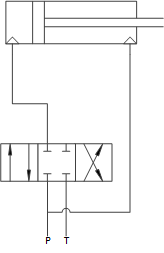
Things to Keep in Mind for this Circuit:
- Reduced extend force. Regen trades force for speed.
- Valve flow. On extend, the valve’s A port carries the full cap-side flow (pump flow plus regen flow), so size the valve for that, not just pump flow.
- The B side is always pressurized. At rest, the cap side must hold about P × (A_annulus / A_cap) to balance it. Valve null and spool leakage therefore matter, and you may need a small null offset or integral action to hold position.
- Fail-safe behavior. If the valve loses power or centers with A open to tank, the cylinder will retract. Make sure that’s the safe direction for your machine.
This is a full-time regen circuit, which may not always be desirable. By adding a three-way valve to switch the cylinder B port between the valve B port and the supply pressure, the circuit can be switched from regen to non-regen on demand. When switching, it is usually best that the axis be in open-loop control.
Load-sensing (automatic) regen valves:
These switch in and out of regen based on system pressure: regen for fast, low-load motion, and normal mode when load builds. They can work, but each switch changes the cylinder’s effective area, which abruptly changes speed, force, and system gain mid-move. For a closed-loop controller, this looks like the plant suddenly changing, and it can cause bumps, overshoot, or hunting near the switching pressure, especially in direction changes and when moving between loaded and unloaded conditions.
Check-valve-based regen circuits:
These use check or pilot-operated check valves to steer rod-side oil. Checks have cracking pressures and open and close based on pressure differentials, not the controller’s command. Around direction reversals and load changes, the flow path can shift unpredictably, which adds nonlinearity and dead zones that are hard to tune out.
Using a Sandwich Valve to Create a Regen Circuit
The recommended full-time regen circuit above is best created by designing the cylinder manifold to block the valve B port and connect P to the cylinder B port. However, it is possible to create the regen circuit by adding this sandwich valve to a normal system:
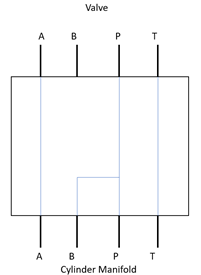
A, P, and T pass straight through. The valve’s B port is blocked, and the cylinder’s B port is tied directly to supply pressure. The valve controls only the A side: when A is connected to P, the cylinder extends, and oil from the B side flows back into the supply (regen). When A is connected to T, the constant pressure on the B side retracts the cylinder. Because no transition valves or checks are involved, the motion stays smooth and controllable in both directions.